
August 11, 2026
Skinny Fat: What It Actually Is and What to Do First
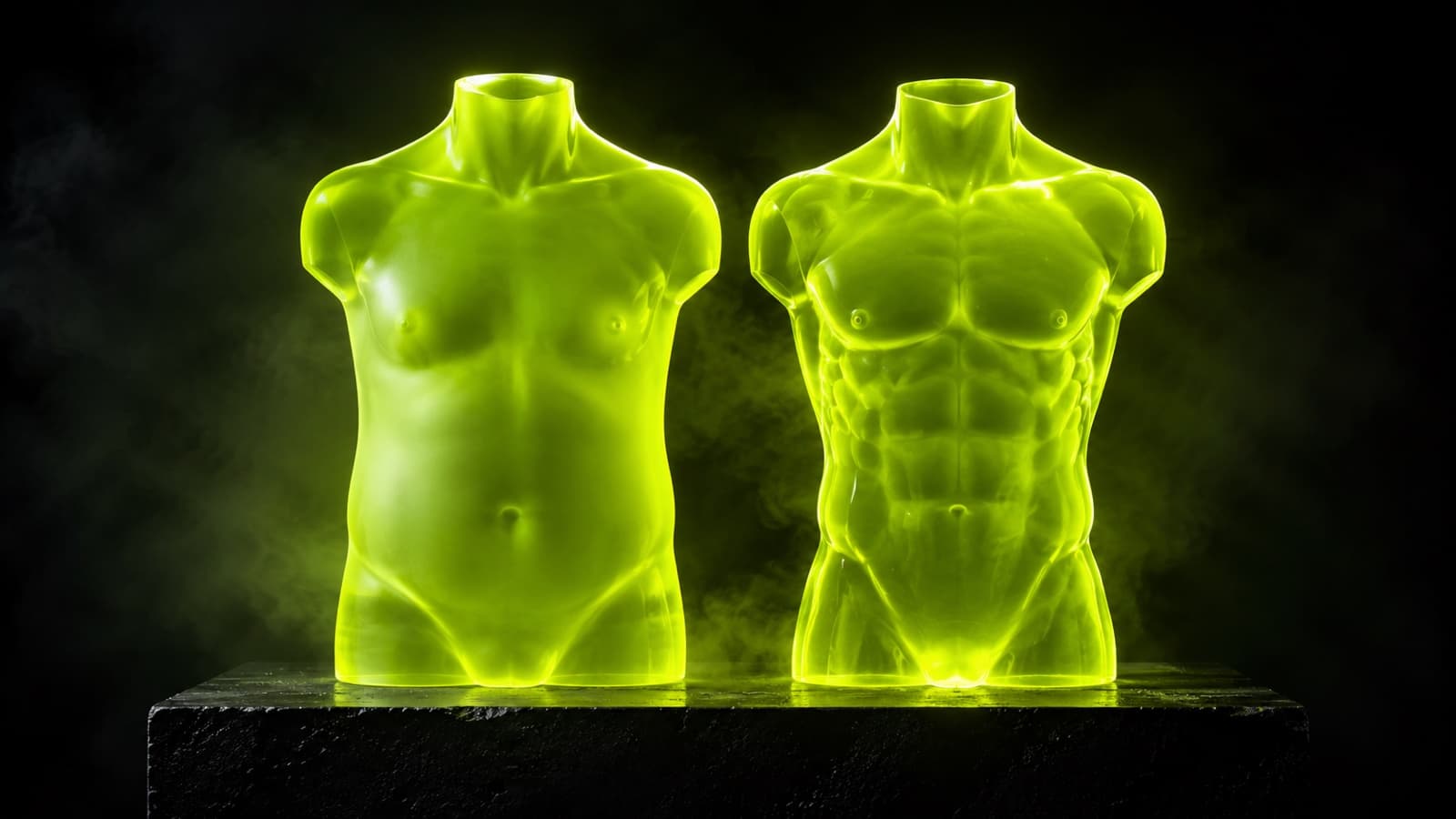
Skinny fat describes a specific body composition: low muscle mass and moderate body fat at a normal scale weight. Dressed, it reads as slim or average. Undressed, it reads as soft, because there is not enough muscle underneath the fat to give the body a shape. The scale is normal, BMI is normal, nothing looks like a problem on paper, and that is exactly why people in this position spend years alternating between diets that make them smaller but not firmer and stretches of giving up entirely.
The right first move is also specific: lift weights, eat enough protein, keep calories near maintenance. Not more cardio, and not a hard cut. The rest of this article is the reasoning, plus what this starting point looks like in a photo-based score and what six to twelve months of doing the right thing actually changes.
What does skinny fat actually look like?
Skinny fat is a ratio problem, not a weight problem. Take two people, both 75 kg at 178 cm, both BMI 23.7. One has trained for years: more lean mass, less fat mass, visible shape. The other has never trained: less lean mass, more fat mass, the same total. The scale cannot tell them apart. A photograph can.
The visual signature is consistent. Shoulders that end where the arm begins, without a cap. Arms with no visible shape at rest. A midsection that carries most of the fat, soft rather than large. No separation between muscle groups anywhere, because separation requires muscle to separate. Legs that have never been asked to do anything. In the male category this typically sits somewhere around 18 to 25 percent body fat; in the female category the equivalent look sits at a higher percentage, because healthy female body fat sits higher at every level. If you want to calibrate your own estimate, the visual body fat guide exists for exactly that.
The usual routes in are consistent too: years of dieting without resistance training, a sedentary decade with occasional bursts of running, or repeated cycles of losing weight and regaining it. Each cycle loses some muscle along with the fat on the way down and regains mostly fat on the way up. The scale returns to its old number. The composition does not.
Why the mirror and BMI both miss it
BMI is weight divided by height squared. It contains no information about what the weight is made of. A skinny-fat body at BMI 23 and a lean trained body at BMI 23 are identical to the formula. BMI was built to describe populations, and at the population level it works; pointed at one individual body it answers a different question than the one you are asking.
The mirror fails differently. You have seen your reflection thousands of times, so you notice what changed this month and skip what has looked the same for years. You see yourself clothed most of the day, and skinny fat is the body type clothes flatter most: slim enough for the shirt to hang well, with nothing underneath the shirt to contradict it. It is also unusually lighting-dependent. Under a harsh overhead light the softness shows; facing a window in the morning the same body looks almost lean. Neither view is a measurement. Both are moods.
This is why the condition survives for years. Every instrument the average person owns, the scale, the BMI chart, the wardrobe, the bathroom mirror, reports that things are fine.
How does skinny fat read in a photo-based score?
Rate My Body scores a physique on five weighted components: proportions 25 percent, muscle development 25 percent, conditioning 20 percent, symmetry 15 percent, harmony 15 percent. The curve is anchored to the general population, not to gym members.
Run a skinny-fat physique through that rubric and the result is predictable. Proportions usually come back fine, because proportions are mostly skeleton: shoulder-to-waist and waist-to-hip sit in the normal range whether or not you train. Symmetry is usually fine for the same reason. Muscle development comes back at 4 to 6 across all six groups, which is the band for an average untrained adult on the 1 to 10 scale. Conditioning comes back middling: enough fat to hide what little muscle there is, not enough to be an outlier. Weigh it all together and the physique lands in Gold, the 45 to 59 band, which is where a normal untrained adult with normal proportions lands, roughly a 5 to 6 out of 10 as a whole body.
Two things about that read matter more than the number. First, Gold is the everyday average on a population-anchored curve. Most people who upload land somewhere between 45 and 80, and a Gold result is not the scale scolding you; it is the scale saying: average, with room in every direction. Second, the diagnostic part is the flatness of the muscle row. A lifter with a weak point has uneven ratings, a 7 next to a 4, and the gap is the plan. A skinny-fat physique has a flat row of 4s, 5s and 6s. Flat and low-middle means the answer is not a specialization block for one lagging muscle. It is muscle, everywhere, for a while.
If you want that baseline on record before you start, a report costs $5 once, with no subscription and no account, and the free photo quality check runs before payment so a bad photo gets rejected rather than billed. One caveat that applies doubly here: a single front photo caps the report's confidence at low, because back and legs are inference from a front shot alone, and back and legs are half of what a skinny-fat rebuild needs to know about.
Why is the fix lifting, not cardio or a hard cut?
Because the problem is a ratio, any fix that only shrinks the total leaves the ratio alone or makes it worse.
A hard cut on an untrained body sheds fat and muscle together. You finish lighter, still shapeless, with even less muscle than you started with, and usually hungrier and less motivated. The result is the same composition at a lower weight. This is the most commonly attempted fix and the most reliably disappointing one.
More cardio has the same flaw from a different angle. Cardio spends energy; it does not build tissue, or not meaningfully in the amounts and intensities most people do it. It is genuinely good for things no photograph can see, and none of this argues against doing it for those reasons. It just does not touch the actual deficit, which is muscle.
What builds muscle is boring and known: progressive resistance training two to four days per week, covering all six major groups, with loads that go up over time. Protein at roughly 1.6 to 2.2 grams per kilogram of body weight per day. Calories at or near maintenance. Sleep. That is the whole prescription. The hard part is not complexity, it is doing it for months without visible feedback, which is what the last section is about.
Why recomposition works unusually well here
Recomposition, gaining muscle and losing fat over the same months, is described online as either a myth or a hack. It is neither. It is conditional, and the conditions read like a description of skinny fat: little training history, moderate body fat. Untrained muscle grows faster in the first year than it ever will again, and moderate fat stores help supply the energy for it. An advanced lifter at low body fat has neither advantage and mostly has to choose a direction. A skinny-fat beginner does not. The mechanics, the numbers and the tracking are covered in the body recomposition guide.
This also dissolves the question that stalls people at this starting point for months: should I cut first or bulk first? For most bodies that question deserves a real answer, and cut or bulk first gives it. For skinny fat it mostly evaporates. You do not need a large surplus, because untrained muscle does not require one to grow. You do not need a deficit, because the scale weight was never the problem. Eat at maintenance, lift, and let the ratio move under a stable total.
What do six to twelve months realistically change?
Months one to three: strength climbs quickly, appearance barely moves. The scale stays roughly where it was, which is correct and feels wrong. Waist measurement drifts down a little; arms and shoulders drift up a little. This is the stretch where most people quit, because every instrument they used to trust reports nothing happening.
Around month six: shape appears in good light. Shoulders get a corner, arms have an outline at rest, the midsection is tighter without having been cut for. Side-by-side photos taken under identical conditions show a clear difference. Strangers notice nothing, and expecting them to is the classic month-six mistake. The honest timeline for muscle other people can see is longer, and how long it takes to build visible muscle walks through it stage by stage.
At twelve months of consistent work: the body visibly trains. Muscle ratings that started at 4 and 5 plausibly sit at 6, with the fastest-responding groups touching 7. The conditioning read improves without a single week of dieting, because the same fat over more muscle reads leaner. A physique that started mid-Gold plausibly finishes at the top of Gold or crosses into Platinum. That is a realistic year, not a guaranteed one; genetics, sleep and consistency all put error bars on it.
One habit makes the whole year easier to believe in: photograph before you start, front, side and back, flat light, and repeat under identical conditions every few months. A fixed rubric applied to fixed conditions is the one progress instrument that does not care how you feel that day. The skinny-fat starting point got hidden by every measure you owned. The fix deserves at least one measure that cannot look away.
Curious how you would score?
Upload a photo and get your AI aesthetics score in minutes.
Get your score