
August 10, 2026
Golden Ratio Physique: Shoulder to Waist Explained
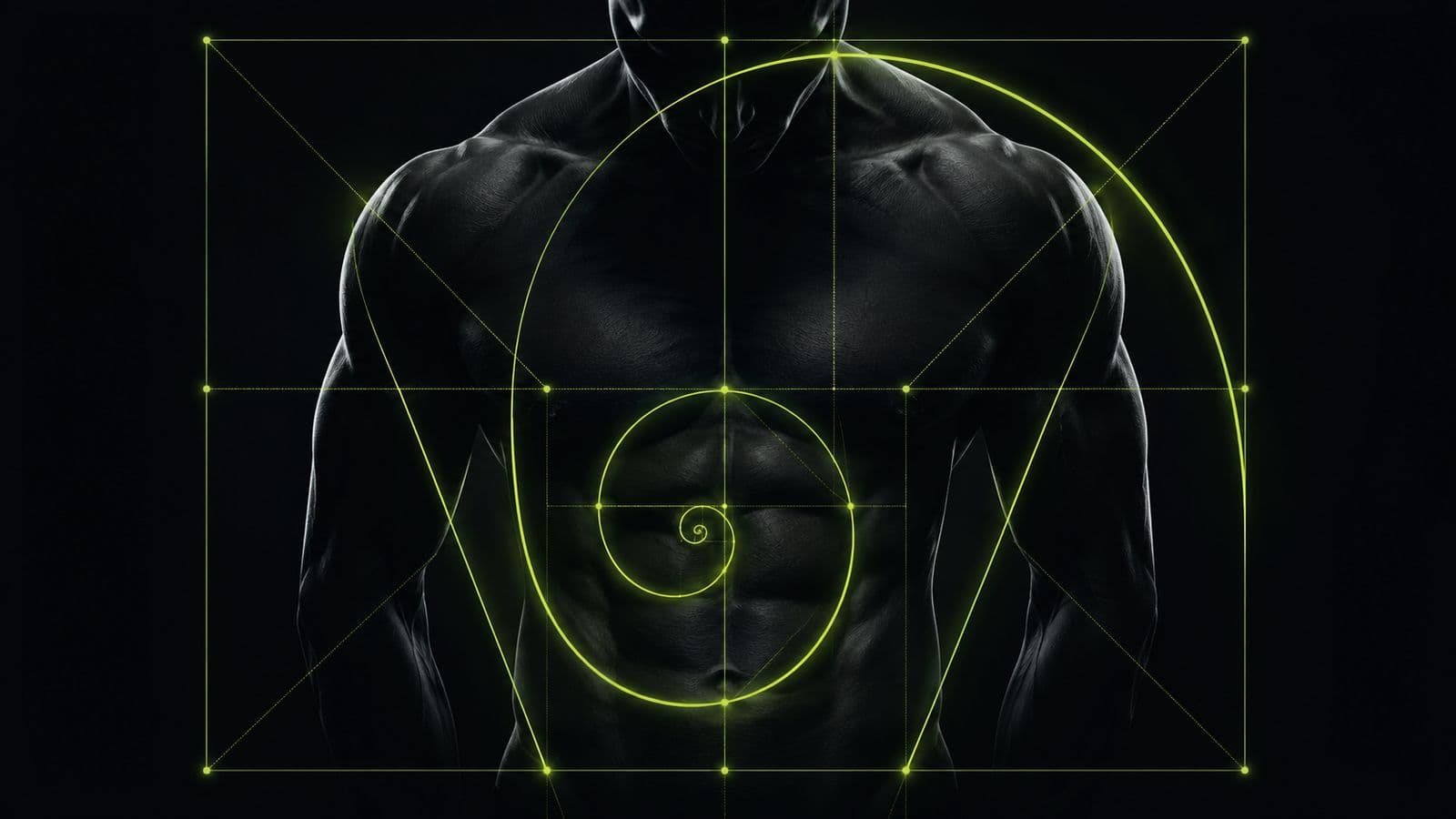
The golden ratio physique is the idea that a body looks best when the shoulders measure roughly 1.618 times the waist. The number comes from phi, the irrational constant that shows up in Greek architecture and Renaissance painting, and it was applied to bodies long before anyone measured whether human beings actually prefer it.
The mystical framing is nonsense. The underlying observation is not. Proportion, meaning the relationship between parts rather than the size of any one part, is the strongest single driver of whether a physique reads as impressive in a photograph, and it is the least understood variable among people who train.
What the ratio actually is
There are two different measurements sharing one name, and mixing them up produces numbers that make no sense.
Shoulder circumference to waist circumference is the classic "Adonis index." Measure around the widest part of the shoulders with arms relaxed at your sides, and around the narrowest part of the waist (usually just above the navel), then divide. The commonly cited ideal is 1.618. Well-built drug-free men typically land between 1.45 and 1.62. Someone who does not train is generally between 1.2 and 1.35.
Shoulder width to waist width is the front-view version, taken from a photograph as two horizontal distances rather than two tape measurements. The two are not interchangeable, and the width version always comes out the larger of the pair. The shoulder girdle is a wide, shallow ellipse, while the waist is much closer to a circle, so at the waist the perimeter grows faster relative to the front-view width. Worked through: a man measuring 125 cm around the shoulders and 82 cm at the waist has a circumference ratio of 1.52. Measure the same body across the front, at roughly 52 cm and 30 cm, and the width ratio is 1.73.
Quoting a width figure against a circumference target, or the reverse, is how people end up convinced they have already passed phi or that they are hopelessly narrow, when neither is true. Decide which measurement you are using and compare it only against numbers taken the same way.
For women the proportion that carries the most weight is different again. Waist-to-hip ratio is the dominant one, with the commonly cited attractive band sitting near 0.7, and shoulder-to-waist matters mainly as part of the shoulder-waist-hip line rather than on its own. A female physique judged only on shoulder-to-waist is being judged on the wrong axis.
What the evidence supports, and what it does not
There is real research on body proportion and perceived attractiveness, and it is more modest than the phi mythology suggests.
Studies asking observers to rate male bodies consistently find that the waist-to-chest ratio (or its inverse) predicts ratings better than weight, height, or BMI do, with the preferred band falling around 0.7 to 0.75, that is, a waist roughly three quarters of the chest. Studies on female bodies consistently find waist-to-hip ratio to be a strong predictor, clustering near 0.7 in the samples most often studied. Preferred overall body size appears to vary more across cultures than the ratio preference does, though the cross-cultural work is thinner than the confident version of that claim implies.
What the research does not support is 1.618 specifically. Nobody has demonstrated that observers can distinguish 1.618 from 1.60 or 1.64, or that phi outperforms any nearby value. The honest statement is: a large shoulder-to-waist difference reads as impressive, the effect flattens out somewhere in the 1.5 to 1.65 region, and the exact constant is decoration.
Steve Reeves, the mid-century bodybuilder whose proportions still anchor the "classic physique" ideal, worked from a different set of ratios entirely, keyed to joint circumferences: arms about 252 percent of wrist, calves about 192 percent of ankle, waist about 86 percent of pelvis, chest about 148 percent of pelvis. Those are useful for the same reason phi is: they scale to your skeleton rather than assuming everyone should hit the same absolute measurement. A man with 16 cm wrists and a man with 19 cm wrists should not be chasing the same arm size.
Why proportion drives a score so heavily
An aesthetics rubric does not contain a line that says "shoulder-to-waist ratio: 1.61." It reads proportion indirectly, through everything a photograph shows: whether the shoulder line is distinct from the trunk, whether the waist reads narrow at the same body fat, whether the upper body balances the legs, whether adjacent groups separate from one another. Proportion is what makes those reads possible.
This is why two people with identical lean body mass can land two tiers apart. Mass distributed into the lateral deltoids, the lats and the upper back produces a V that photographs well from the front and the back. The same mass distributed into the abdominal wall, the obliques and the lower back produces a thicker torso that reads as smaller overall, even though the scale disagrees.
It is also why the mid-range of the tier ladder moves fastest on proportion work. Going from Gold into Platinum rarely requires an extra 5 kg of total muscle. It usually requires the same body with wider shoulders, a more complete back, and a waist that has not grown along with everything else. The full picture of what the rubric weighs is in what an aesthetics score measures.
What you can change, and what you cannot
Honest accounting matters here, because the ratio has both a trainable numerator and a mostly fixed denominator.
Fixed, or nearly so: clavicle length, rib cage width and depth, pelvic width, and limb-to-torso proportions. These are skeletal. Wide clavicles are why some people look broad at 70 kg while others do not look broad at 90 kg. No training modality changes bone dimensions in an adult, and any product claiming otherwise is lying.
Highly trainable: lateral deltoid mass, upper back thickness and width (lats, teres major, traps), and the visible taper those create. The lateral delt in particular is one of the highest-leverage muscles in the body for perceived proportion relative to its actual size, because it sits at the widest point of the silhouette. Adding one centimeter of shoulder width per side is worth far more visually than adding the equivalent tissue to the arm.
Partly controllable: waist size. Some of it is fat, which is the fastest component to change and the one covered in the body fat visual guide. Some of it is trained oblique and abdominal thickness, which is why heavy loaded rotation and heavy weighted side work can measurably widen a waist over a couple of years. And some of it is simply the width of your pelvis and rib cage, which is not going anywhere.
A realistic expectation: a trained lifter who prioritizes lateral delts and upper back for a year, while holding waist size constant, can commonly move a shoulder-to-waist circumference ratio by 0.05 to 0.10. That sounds small on paper and is clearly visible in a side-by-side photograph.
How to measure yours without fooling yourself
Use a fabric tape, stand relaxed rather than flexed, exhale normally rather than sucking in, and measure at the same time of day, ideally in the morning before eating. Take three readings and use the median. Measure the shoulders at the widest point with the arms hanging, not held out, and the waist at the narrowest point rather than at the navel if the two differ.
If you are estimating from a photograph instead, the same rules that govern any visual assessment apply: shoot from chest height rather than from below, keep the camera far enough away to avoid the wide-angle distortion that makes near-side shoulders look enormous, and stand square. The physique photo guide covers the setup in detail, and a badly framed photo can shift an apparent ratio by 10 percent in either direction.
Turning the ratio into a training decision
If your shoulder-to-waist is below about 1.4 as a man, the answer is almost always more upper back and more lateral delt, not more chest and arms. Most people who train for years and stay narrow have trained the mirror muscles and neglected the ones that create width.
Practically, that means:
- Lateral raises done with real weekly volume (10 to 20 hard sets, spread across at least two sessions), not two token sets at the end of a push day.
- Horizontal pulling for upper back thickness and vertical pulling for lat width, both progressed on load, not just repeated.
- Enough restraint on direct heavy oblique work if waist width is already your limiting factor.
- Conditioning held at a level where the waist is not carrying additional fat.
Those are weak points in the specific sense that they are the constraint on your score, and the sequencing logic behind fixing weak points first applies directly.
One closing caution against chasing the number too literally. The people who look best are not the ones who hit 1.618 on a tape, they are the ones with complete physiques where no single region drags the rest down. Proportion is a diagnostic, not a destination, and a ratio achieved by having no legs is a worse physique than a slightly lower ratio attached to a body that is finished everywhere.
Curious how you would score?
Upload a photo and get your AI aesthetics score in minutes.
Get your score