
August 10, 2026
How Aesthetic Is My Body? What a Score Measures
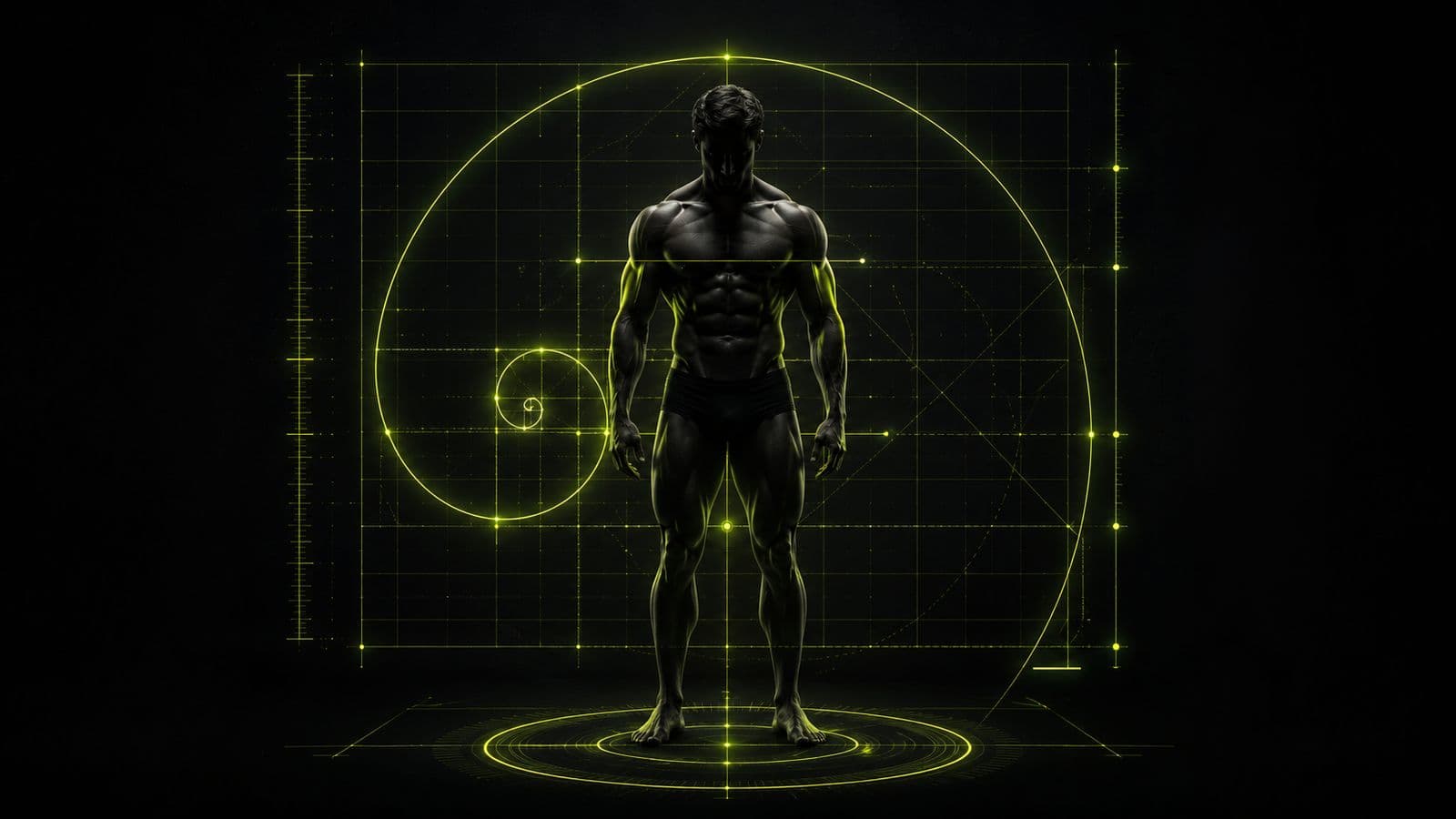
"How aesthetic is my body" is a question with no mirror-based answer. You have seen your own reflection thousands of times, which is precisely why you cannot judge it: you notice the parts that changed this month and skip the parts that have looked the same for two years. Friends will not tell you your back is untrained. The gym mirror has good lighting and a flattering angle, and you have learned, without meaning to, exactly where to stand in it.
A score is useful because it is indifferent. It looks at the same four things on every person, in the same order, and puts a number on them.
What an aesthetics score actually measures
Physique aesthetics is not one quality. It is four, and a good rubric reads them separately before combining them.
Muscle development. How much muscle is there, relative to your frame. Not how strong you are, and not how much you lift. A powerlifter with a 250 kg deadlift and a 190 kg squat can score in the same band as a hypertrophy-focused lifter with far less strength, because a photograph shows tissue, not force output.
Conditioning. How much of that muscle is visible. Body fat sits between muscle and camera, and it decides whether "developed shoulders" reads as a shape or as a smooth outline. Two people with identical lean mass can sit tiers apart at 10 percent and 24 percent body fat. This is also the fastest-moving variable in most people's scores, which is why the visual body fat guide is worth reading before you make plans.
Proportion. The relationships between parts: shoulder width against waist, waist against hips, upper body against legs, arms against torso. Proportion is why two people with the same total muscle mass do not look equally impressive. It is the oldest idea in physique aesthetics and the one with the most math behind it, covered in the golden ratio piece.
Symmetry and completeness. Left against right, and front against back. Completeness is the one most people fail. A physique that looks excellent from the front and has nothing behind it is not an excellent physique, it is a well-photographed one.
Rate My Body scores each of the six major groups (arms, shoulders, chest, back, abs, legs) on a 1 to 10 scale, read against the general population: 5 to 6 is the average untrained adult, 7 is noticeably developed, 8 to 9 is a consistent gym-goer whose development stands out, and 10 is world class. The overall 0 to 100 score is not an average of those six numbers. Both readings are made against the same rubric, in parallel: the group ratings say how developed each region is, and the overall score says how the whole body reads on the ladder, proportions first. Proportions and muscle development carry the most weight (a quarter each), conditioning slightly less, with symmetry and overall harmony making up the rest. They should point the same direction, and when you read a report the six numbers are the more actionable half.
What the tiers mean
The 0 to 100 score maps to seven tiers with fixed bands:
- Iron (0 to 14): an extreme outlier, far below the everyday average. Severely underweight with no muscle carrying the frame, or body fat high enough that no shape reads at all. An ordinary untrained body never lands here.
- Bronze (15 to 29): well below average. The silhouette reads heavily off balance, with proportions lost to body fat or extreme thinness and no visible tone anywhere to compensate.
- Silver (30 to 44): below the everyday average. Proportions read noticeably off, conditioning sits below the everyday norm, and no muscle tone shows to compensate.
- Gold (45 to 59): the everyday average, a solid 5 to 6 out of 10. Normal proportions at a healthy-looking weight, little visible muscle development. A normal untrained adult lands here, and natural proportion decides the top or bottom of the band.
- Platinum (60 to 74): above average, visibly fit. Visible tone in the shoulders, arms or glutes, and a shoulder-to-waist or waist-to-hip line clearly better than the everyday norm.
- Elite (75 to 89): fit and developed, an 8 to 9 out of 10. Muscle visible across most groups with real separation and a strong taper. Stands out at a gym or a beach. This is where a consistent, serious gym-goer belongs.
- Apex (90 to 100): exceptional. Near-ideal proportions, development, conditioning and symmetry all present at once, complete from every angle. Only an extreme minority of the population ever reaches it.
The distribution matters more than the ladder. The curve is anchored to the general population, not to a stage lineup, and it is deliberately generous: among people who choose to upload physique photos, most land somewhere between 45 and 80. An untrained adult with an average build and normal proportions lands in Gold, not at the bottom of the ladder, and a genuinely consistent lifter with a few years of serious work behind them belongs in Elite. If you train seriously and score in the high 70s, the number is not flattering you. That is where a developed, visibly fit physique sits on a curve where only Apex is rare.
Scoring in the 60s means you read as above average and visibly fit. Scoring 75 or above means your development stands out at a gym or a beach, and Apex stays what it sounds like: an extreme minority of the population.
Because the bands are fixed, they also make comparison possible without anyone having to post their body anywhere. Scores can go on a public leaderboard, but that is opt-in and carries only a nickname you pick: no name, no photos, nothing you did not choose to show. If you want to know which band you land in, that read costs $5 once, with no subscription and no account, and the photo quality check runs before payment so a badly lit shot sends you back to retake it rather than quietly taking your money.
What the score does not measure
This part is not a legal disclaimer, it is a correction to how people read numbers.
It is not a health metric. Aesthetics and health overlap only in the middle of the range and diverge sharply at both ends. A stage-lean Elite physique photographed at 5 percent body fat is not a healthier body than the same person twelve weeks later at 12 percent, it is a leaner one. Nothing in a photograph tells you anything about blood pressure, lipids, glucose control, joint health, or sleep. If you want those numbers, they come from a doctor and a blood draw, not from an app.
It is not a statement about you. The score describes photographed aesthetics on a specific day. It is a snapshot of a body's current training state, which is a small and changeable fact about a person.
It is not strength, athleticism, or attractiveness. Attraction is individual and contextual in ways no rubric captures. A rubric can tell you your back is a 4 and your arms are a 7. It cannot tell you what any particular human being finds appealing.
Where photo-based rating has error bars
Any visual estimate has an error bar, and honest products state theirs.
Lighting is the biggest single source of noise. Two photographs taken ten minutes apart, one under a ceiling spot and one facing a window, can support visibly different conditioning estimates of the same unchanged body. Nothing about the physique moved. The shadows did.
One photo hides the majority of a physique. From a front shot alone, back development and most leg detail are inference rather than observation, so a report's confidence rating is capped: a single photo cannot rise above low confidence no matter how good it is. What that ceiling protects you from is a confident wrong answer. Supplying the missing views does not push a score up, it makes it correct, and scores move down about as often as up once the back is genuinely visible.
Short-term variables move the read. A pump adds visible size for about an hour. Sodium and carbohydrate intake change how you hold water day to day. A tan increases apparent definition without changing a single fiber. None of this is fraud, it is just noise sitting on top of the signal.
Estimates should be worded as estimates. This is why body fat comes back as a range ("14 to 17 percent") rather than a decimal. A number like 15.2 percent from a photograph would be false precision, and a product that hands you one is selling confidence it does not have. The photo guide exists mostly to shrink these error bars, and it is the single highest-leverage thing you can do before uploading.
Male and female physiques are judged on separate scales
A score means the same thing in both categories: the same amount of training, conditioning and completeness relative to what is achievable in that category. It does not mean the same absolute muscle mass.
The differences that are real: absolute mass is lower in the female category at every level, so mass is judged relative to the category rather than in absolute terms. Healthy conditioning bottoms out at a higher body fat level, so visible abdominal definition arrives later and is not required as early. In the male category upper body mass tends to dominate the read, while in the female category glute, hamstring and quad development together with shoulder-to-waist-to-hip proportion carry comparable weight.
A female physique is never scored by asking how it compares to a male one. That is a category error, and it is the failure mode of most casual rating.
How to actually use a score
The overall number is the part people share and the least useful part for training. The per-muscle breakdown is where decisions live.
If your arms rate 7 and your back rates 4, you already know your next training block. Adding another arm day will move your overall score by almost nothing, because arms are already at the point of diminishing returns for you, while the back sits at the bottom and is weighted heavily in every proportion measure. That gap is the entire argument for training weak points first.
The second good use is as a fixed reference point over time. Score once, train for four to six months, photograph under the same conditions, score again. Because the rubric does not drift and does not know your history, the comparison is honest in a way that progress photos judged by your own eye never are.
The one thing worth settling before you set a target is what natural physique standards actually look like, because the Apex band is where the conversation about drug-free ceilings begins, and aiming at a number that most drug-free bodies do not reach is a good way to spend five years feeling like a failure while doing everything right.
Curious how you would score?
Upload a photo and get your AI aesthetics score in minutes.
Get your score