
August 11, 2026
What Makes an Aesthetic Female Physique? The Real Standards
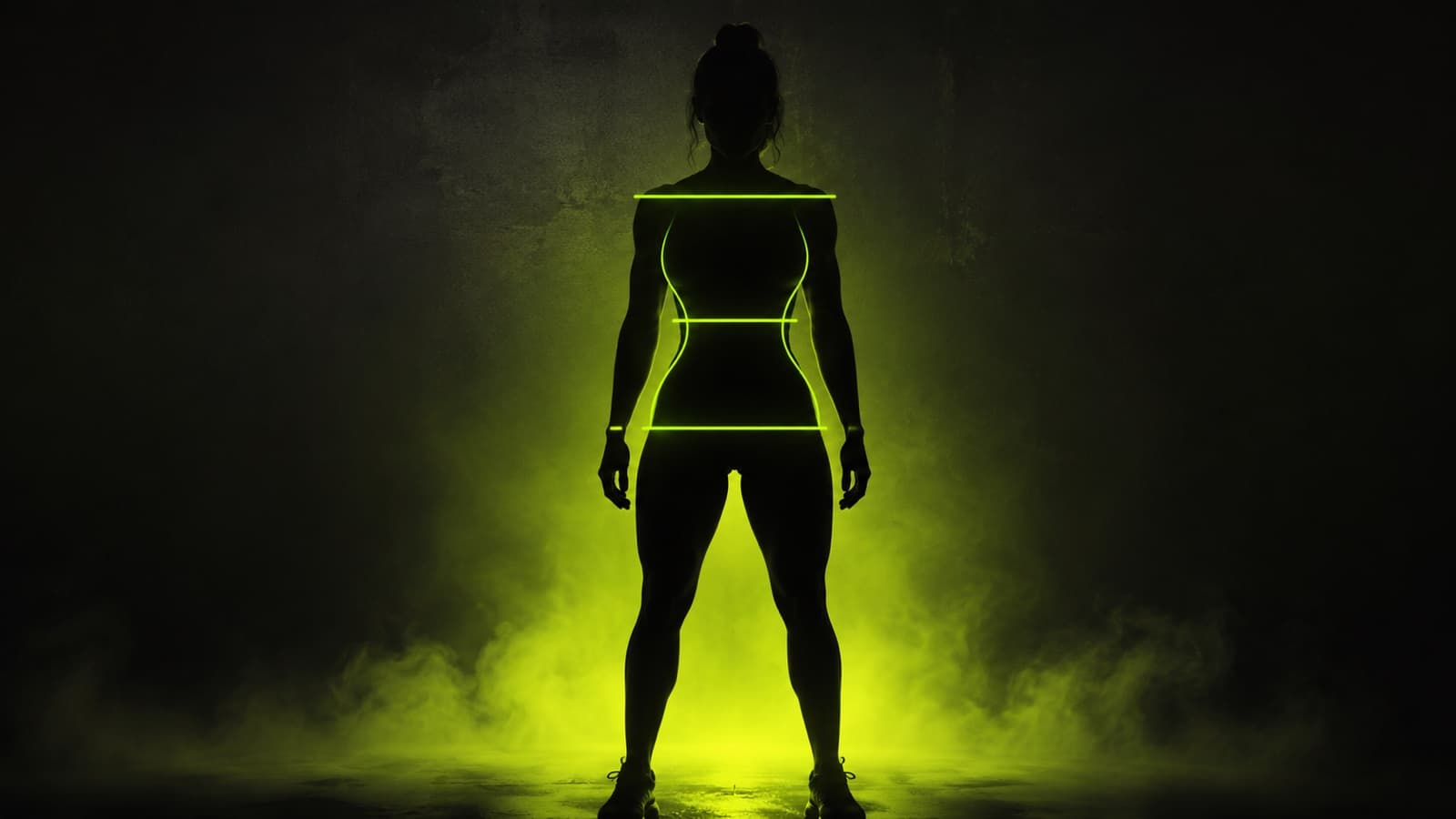
An aesthetic female physique is built on proportion before size: a clear waist-to-hip line, developed glutes, hamstrings and quads, shoulder-to-waist balance, and an hourglass silhouette rather than a V-taper. Female physique standards are a category of their own. A female physique is judged against what the female category actually produces, never against male criteria, and most of the bad judgment aimed at women's bodies comes from someone applying the wrong rubric.
Most physique writing, including most of this blog, defaults to the male read: chest, lats, the six-pack, the taper. This article is the corrective. It covers what drives the score in the female category, where the tiers concretely sit for women, why the feed is a broken reference point, and which training actually moves the number.
What makes an aesthetic female physique
Rate My Body scores both categories with the same weights: proportions 25 percent, muscle development 25 percent, conditioning 20 percent, symmetry 15 percent, harmony 15 percent. What changes between the categories is not the weights. It is what the eye, and the rubric, are looking for inside each one.
The waist-to-hip line. In the male category the defining relationship is shoulders against waist. In the female category the defining relationship sits lower: the waist against the hips, and how clearly that line is drawn. It is the single strongest driver of the read, and it is mostly the product of two things you can train, a developed glute and a controlled midsection, sitting on one thing you cannot, pelvic structure.
Glutes, hamstrings and quads. In the female category, lower body development carries comparable weight to the upper body. A physique with developed glutes and hamstrings and an untrained upper body reads as incomplete, but so does the reverse, and the reverse is the rarer problem. The most common version of a strong female physique is built from the ground up.
Shoulder-to-waist balance. Shoulders still matter, just differently. Built side delts widen the top of the silhouette, which makes the waist read smaller and closes the hourglass. The goal is balance with the hips, not the maximum-width taper the male category chases.
The hourglass, not the V-taper. Put together: shoulders and hips in balance, a clearly narrower waist between them, and visible development in the glutes and legs. That is the shape the category rewards. The math behind why proportion dominates the read is the same in both categories and is covered in the golden ratio article.
Female physique standards are category standards
Absolute muscle mass is lower in the female category at every level. This is a fact about the category, not a deficit, and the scoring treats it that way: mass is judged relative to what the category produces, not in absolute terms. A woman with genuinely developed shoulders is not compared to a male deltoid and found small. She is compared to female shoulders across the population and found developed.
The same logic runs through the six muscle ratings in a report. Arms, shoulders, chest, back, abs and legs are each scored 1 to 10 against the female distribution: 5 to 6 is the average untrained adult, 8 to 9 is a standout gym-goer, 10 is world class. An 8 on female shoulders means exactly what an 8 means on male shoulders: near the top of what the category's population actually walks around with. What the full report contains and how the overall score is assembled is covered in the score breakdown.
Why does definition arrive at a higher body fat?
Healthy conditioning bottoms out at a higher body fat level in the female category. That is a fact about the category standard, stated plainly, not advice: the rubric expects it, and does not ask female conditioning to imitate male numbers.
Two practical consequences follow. First, definition arrives at a higher body fat than in the male category. A female physique starts to read as defined, with shape in the shoulders, separation in the legs, a clear waist, at a level where an equivalent male physique would still look soft. Second, visible abs are not required as early on the ladder. In the male category, ab visibility is a mid-ladder expectation. In the female category it arrives later and is weighted accordingly: a woman can score Platinum with a strong silhouette and no etched midsection, because the rubric reads the category honestly instead of importing a male checklist.
If you want to see what different levels actually look like on a female body, the visual body fat guide covers both categories and is the right reference before you decide anything about a cut.
Where do women land on the tier ladder?
The bands are fixed and identical in both categories. What lands where, concretely, in the female category:
- An untrained woman with normal proportions lands Gold (45 to 59). Gold is the everyday average, roughly a 5 to 6 out of 10, and normal proportions are worth real points because proportion is a quarter of the score.
- A woman who has lifted consistently for a few years, with developed glutes and shoulders and a maintained waist, lands Elite (75 to 89). Elite is 8 to 9 out of 10 territory: fit and developed, the band where a serious, consistent gym-goer belongs.
- Platinum (60 to 74) sits between them: above average and visibly fit, the usual result of a year or two of honest training, or of very good proportions plus some development.
- Apex (90 to 100) is an extreme minority of the population, in either category.
- Below Gold, Silver (30 to 44), Bronze (15 to 29) and Iron (0 to 14) describe physiques below the everyday average, and the bottom two are genuine outliers.
Most people who upload land between 45 and 80. The curve is population-anchored and generous, and it measures how the body looks as a whole, proportions first, not training history. Nobody is docked points for not having a gym membership.
Why social media is not a standard
The reference point most women actually use is not a rubric. It is a feed, and the feed is distorted in one direction only.
A physique photo on social media is the best frame out of dozens, taken with a pump, under chosen lighting, at a chosen angle, often posed by someone whose job is posing. Increasingly it also sits on top of surgery or pharmacological enhancement that is almost never disclosed. Every one of those layers moves the image away from what an unposed body looks like, and the aggregate effect is a reference point where normal reads as inadequate and above-average reads as barely acceptable.
A fixed rubric is a saner reference for one reason: it does not move. It is anchored to the population, not to the feed, and it will tell a normally proportioned untrained woman that she is average, in a band called Gold, rather than implying she is a before photo. If you want that read on your own photos, it costs $5 once, with no subscription and no account, and a free photo quality check runs before payment, so a bad photo gets sent back for a retake instead of billed.
Training that actually moves the score
The score rewards the silhouette, so effective training concentrates on the parts that draw it.
Glute and hamstring volume first. Hip thrusts and heavy hinging for the glutes, Romanian deadlifts plus leg curls for the hamstrings, squats or leg press for the quads. For most women this is where the largest share of available points sits: it develops the exact regions the category weights most, and it sharpens the waist-to-hip line from the hip side. Ten to sixteen hard sets per week for the priority region, spread over two or three sessions, is a realistic working range.
Side delts for the shoulder line. Lateral raises, two or three short sessions a week, light enough to control and progressed patiently. Wider shoulders balance the hips and make the waist read narrower without the waist changing at all. It is the cheapest proportion improvement available in the female category.
Nothing shrinks the waist directly. Waist trainers compress soft tissue while they are worn and change nothing once they are off; they do not move a score by a single point. Spot reduction does not exist: ab work builds ab muscle and removes none of the fat above it. A waist gets smaller through overall fat loss and reads smaller through wider shoulders and fuller glutes. Those are the levers. There are no others.
The same photo standards apply
None of the above changes how to photograph. The physique photo guide applies unchanged: flat, even light, the whole body in frame, a relaxed standing pose, front, side and back.
Two points matter more in the female category. One photo caps report confidence at low, and from a front shot alone the back and legs are inference rather than observation. In the female category that means the highest-value regions, the glutes and hamstrings, are being guessed at. If your lower body is your strongest feature, and for most trained women it is, the back photo is the one that proves it.
Score once, train the levers above for a few months, photograph under the same conditions, score again. The rubric does not follow trends and does not care what the feed decided a woman should look like this year. That indifference is the entire value.
Curious how you would score?
Upload a photo and get your AI aesthetics score in minutes.
Get your score