
August 11, 2026
Why Do I Look Different in Photos Than in the Mirror?
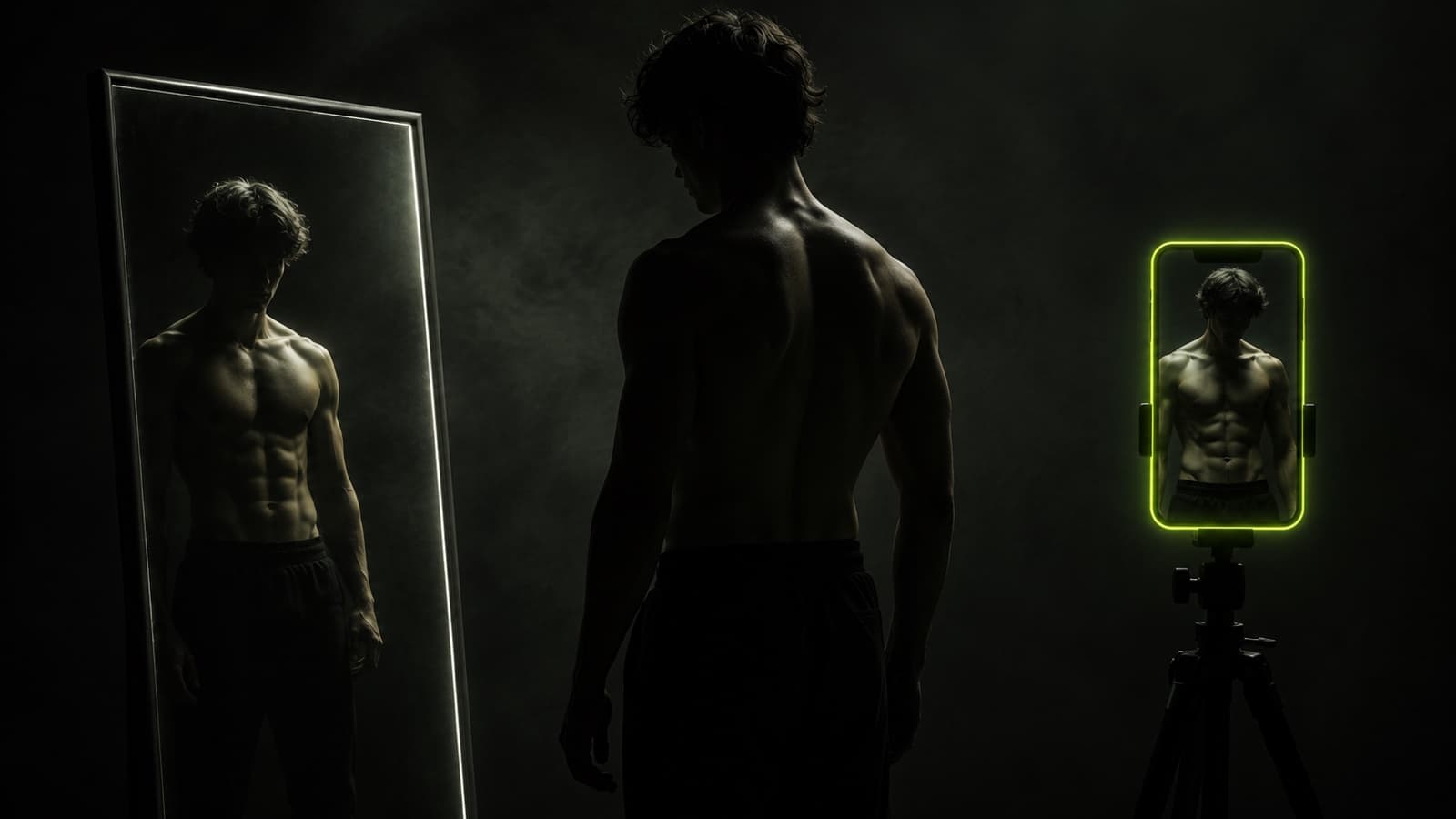
"Why do I look different in photos" has two answers, one about optics and one about psychology, and both work against you at the same time. The short version: the mirror shows you flipped, moving, self-corrected and lit the way you have learned to like, while a photo shows you un-flipped, frozen, at a distance you did not choose, often through a lens that is actively distorting you. Neither image is a lie. They are two different measurements of the same body.
The part that matters: of the two versions, the photo is much closer to what other people see. That is uncomfortable, but it is also useful, because it settles which image you should trust when you want to know whether your body is actually changing.
The mirror is flipped, and you are trained on the flip
No face or body is symmetric. Your hair parts on one side. One eyebrow sits higher. One shoulder rides slightly above the other, one pec or one lat is a little fuller, your jaw is not a perfect mirror of itself. None of this is a flaw. It is the default state of human bodies.
The mirror reverses all of it, and you have spent tens of thousands of glances learning that reversed version as "what I look like." A photo puts every asymmetry back on its true side. Your brain registers each small feature as being in the wrong place and files the whole image under "off" without being able to say why. Nothing changed except left and right.
You pose in the mirror without knowing it
By the time you are an adult you have run the mirror routine so many times it no longer feels like a routine. You turn a few degrees to your better side. You lift your chin to a specific height. You square the shoulder that droops, shift your weight onto the leg that makes your hips sit level, and stand at the exact spot in the bathroom where the light does the most work. All of it happens in under a second and none of it is conscious.
A camera does not wait for the routine. Someone photographs you from the side you never present, at a chin height you never use, mid-step, and you conclude the photo "caught you badly." It did not. It caught you unposed, which is a state the mirror has not shown you in years.
What does the front camera do to your face and body?
This part is pure geometry. A lens close to a subject enlarges whatever is nearest to it, because near things occupy more of the frame than far things. A phone front camera at arm's length sits well inside the distance where this matters: the nose and the center of the face render wider, the ears recede, the forehead grows, and an arm or shoulder pushed toward the lens balloons out of proportion. The same effect at a lower angle stretches whichever limb is closest.
Move the camera back and the distortion collapses. A rear camera at 2 to 3 meters renders your proportions roughly the way a person standing at conversational distance sees them. That is the honest configuration, and it is why every serious progress protocol specifies it. A selfie is not a slightly worse photo of you. It is a photo of a version of your face that does not exist at normal viewing distances.
Lighting direction decides how much definition you have
Overhead directional light, the kind most gyms install, throws shadows downward: under the chest, into the abs, under the delts. It carves separation into a physique that has any. Flat frontal light, the kind most bathrooms have, fills every shadow and erases the same separation. Same body, ten minutes apart, visibly different conditioning.
So the gym mirror flatters you twice, once with the light and once with your rehearsed angle, and the harshest fitting-room photo undersells you twice in the opposite direction. Neither is the truth. The truth is that lighting is a variable, and any comparison that does not hold it constant is measuring the light, not you.
A photo is one frame, the mirror is a directed film
In the mirror you never see a bad millisecond. You are watching a live feed with continuous correction: the instant something looks wrong you adjust, and your memory keeps the corrected frames. A photo is a single frame sampled from the uncorrected stream, sometimes mid-blink, mid-word, mid-breath, weight on the wrong foot.
Candid photos feel so much worse than mirrors partly because they are drawn from exactly the frames you would have edited out live. Other people, watching you move in real time, never see you as a frozen frame either, which is worth remembering before you treat one bad candid as the truth about your body.
The mere-exposure effect: you prefer the face you see more often
Psychology has a name for the last piece. The mere-exposure effect is the well-documented tendency to prefer things you have encountered more often, and it applies to your own image: in classic experiments, people tended to prefer the mirrored version of their own portrait, while their friends preferred the true version, each group choosing the orientation they had seen the most.
So the photo does not just look different to you. It looks slightly wrong to you specifically, while looking completely normal to everyone else. The discomfort you feel toward un-flipped photos is a measure of your exposure history, not of the photo's accuracy.
Which version do strangers actually see?
The photo version, with one correction. A stranger sees you un-flipped, at conversational distance, in whatever light the room provides, exactly as a decent rear-camera photo does. But a stranger also sees you moving, so the frozen-frame penalty does not apply to them. In practice the closest thing to "how you look to other people" is a rear-camera photo taken from a few meters away in even light, not your mirror and not your worst candid.
Nobody you meet has ever seen your mirror image. The version of you that you know best is the one version no one else gets.
How to make photos an honest progress record
The mirror cannot track progress: it is flipped, posed, lit to flatter, and attached to an observer who has habituated to the subject. Photos can, but only if you strip out the variance that this article has been listing. The protocol is short:
- Same spot, same background, same time of day. Morning, before eating, is the usual anchor.
- Same light. One fixed, even source. Not the gym, not a window whose light changes by the hour.
- Rear camera, 2 to 3 meters away, timer or a tripod. Never the front camera at arm's length.
- Same framing and same poses, relaxed. Front, side and back, whole body in the frame.
Do that every time and the only thing left that can change between two photos is your body. The full setup, including the mistakes that quietly ruin comparisons, is in the physique photo guide.
Where an AI rating fits
Everything above describes one problem: the observer is compromised. You are habituated to your own reflection, you prefer the flipped version, you pose without noticing, and you judge each photo against a memory that edits itself. An outside human eye fixes some of that, but friends are polite and your own eye never resets.
An AI rating is built for exactly this gap. It reads the same photo standards for every person who uploads, it applies the same rubric to your photos this month and six months from now, and it never gets used to your face, because it does not remember it. Rate My Body scores a physique from one to three photos for $5, one time, no subscription and no account, and a free photo quality check runs before payment, so a shot too poor to score honestly gets rejected before it costs you anything. The curve is anchored to the general population rather than to gym members: a normal untrained adult with normal proportions lands in Gold, the 45 to 59 band, and most people who upload land somewhere between 45 and 80. What the score actually measures, proportions first, is covered in the score breakdown, and the honest error bars of judging a body from photographs are covered in the accuracy piece.
The mirror will keep showing you the rehearsed, flipped, self-corrected version, and there is nothing wrong with liking it. Just do not use it as an instrument. For measuring, use the image that holds still, the one everyone else already sees.
Curious how you would score?
Upload a photo and get your AI aesthetics score in minutes.
Get your score